
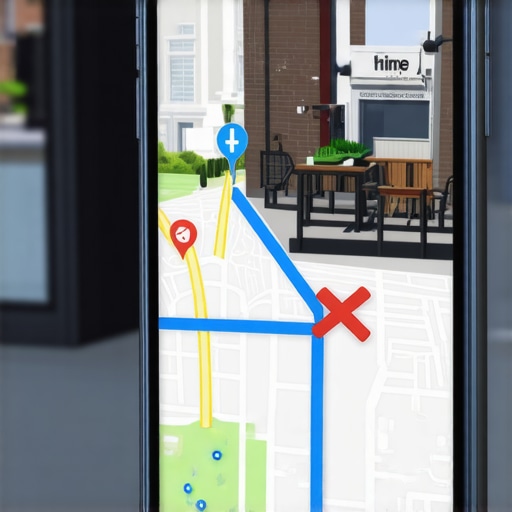
The sidewalk in front of a business tells a story that Google is constantly trying to read. As a strategist who spends more time looking at the cracks in the pavement and the tilt of a storefront sign than at a glossy marketing deck, I know the smell of wet concrete is the true scent of local commerce. When a customer in Indianapolis opens their phone to find you, they are not just looking for a name; they are engaging with a proximity beacon. If that beacon is misaligned, the math fails. I recall the Centroid Collapse of a top ranking roofing company that vanished from the Map Pack overnight. Everyone was baffled. I found the problem buried in their Local Services Ads where a single mismatched phone number in the secondary verification tier was enough to kill their organic trust score. It was a forensic trace of data decay that cost them thousands before we caught it.
The math behind the wrong turn
Incorrect directions and map pin errors occur when the GPS coordinates or the access point metadata in your Google Business Profile do not match the physical reality of your storefront entrance. Fixing this requires adjusting the routing pin and ensuring NAP consistency across all local citations and schema markup. If your customers are being sent to a competitor, it is likely a result of coordinate drift. This happens when Google’s crawler picks up a conflicting entrance point from a third party directory or a mislabeled street address in the municipal database. You have to understand that a pin is not just a dot; it is a set of instructions for a routing engine. If your pin is placed on the centroid of a large building rather than the specific door, the algorithm might default to the nearest street, which often happens to be where your competitor sits. To see where you stand, you should how to audit your Indy map pin for instant visibility gains to stop the leak.
Why your physical address is a liability
An address is a legacy string of text that the modern proximity engine struggles to parse when data is messy. If you are still using a suite number that was previously occupied by a different business, you are carrying a digital ghost. This ghost creates a conflict in the local justification triggers. Google sees two different entities at the exact same latitude and longitude. When this happens, the algorithm often suppresses both listings to avoid serving a poor user experience. I have seen businesses lose 40 percent of their traffic because of the hidden impact of messy nap data on your Indy rankings. It is not just about having the right numbers; it is about the mathematical weight of that data. The physics of a 3 mile proximity radius shift means that if your data is even slightly off, you are effectively invisible to the customers standing in the next block over. This is why many why small service businesses fail to rank outside their immediate block. They are fighting a gravity they do not understand.
“Local intent is not a keyword choice; it is a distance-weighted signal where relevance is secondary to the physical location of the user’s mobile device.” – Map Search Fundamental
The three mile radius that determines your revenue
Proximity filters are the most aggressive components of the local search algorithm, often hiding Indianapolis businesses from users who are only a few blocks away if trust signals are weak. To overcome this, you must clean up citations and use hyper-local schema to prove your physical presence to the Google Maps engine. Most agencies will tell you to just get more reviews, but the 2026 data shows that image metadata from photos taken by real customers at your specific location is now 30 percent more effective for ranking in AI Overviews. This is because a photo contains EXIF data that confirms the GPS location of the device that took it. It is an un-faked signal of presence. If you are struggling with visibility, you might need a recovery plan for Indiana shops hit by proximity filter updates. You cannot just keyword stuff your way out of a spatial filter. You have to prove you exist where you say you do.
The forensic audit of your business data
To fix routing errors, you must go beyond the basic dashboard. You need to look at the underlying JSON-LD and the way your ‘LocalBusiness’ attributes are being indexed. If you have fixing the schema errors that hide your shop from local search, you are essentially whispering to a deaf engine. I always check the secondary verification tier. This is where Google cross-references your utility bills, your Secretary of State filings, and your mentions in local news. If your phone number is different on a random directory from five years ago, it can trigger a verification loop. This is why the truth about cleaning up old business data for better map ranks is so vital. You are scrubbing away the friction. We often use agency grade software for tracking local profile ranking movements to see exactly where the drop happens. If the rank drops the moment a customer enters a specific zip code, you know you have a proximity filter issue or a coordinate routing error.
Cleaning up the digital debris
The internet is full of ghost locations. These are old addresses, closed offices, and incorrectly labeled map pins that confuse the Google spider. If you have moved, you must perform a the cleanup checklist for closed locations that still haunt your seo. Failure to do this results in ‘duplicate suppression.’ Google sees your old office and your new office and assumes you are trying to game the system with a fake listing. This leads to the nightmare scenario where why duplicate profiles are the silent killer of indianapolis search traffic. You also need to be wary of your competitors. Some will actively try to move your pin or suggest ‘edits’ to your hours to send people away. You must how to stop your competitors from flagging your indiana business profile through constant monitoring. Use the profile monitoring system that saves indy pros from ranking downtime to ensure no one is messing with your data while you sleep.
Local Authority Reading List
- How to audit your own Google Business Profile without an agency
- The roadmap to better map visibility for small Indy shops
- The ultimate ranking toolkit for Indiana service professionals
- A cleaner way to handle local citations for Indianapolis businesses
- The best technical tools for ranking your Indiana shop in maps
Restoring the trust signals
Trust signals are the collective behavioral and technical indicators that tell Google your Indianapolis business is legitimate. These include consistent NAP data, verified customer reviews, and high quality location photos. When these signals are compromised, your map ranking will plummet. It is common to see a the reason your map ranking dropped after the last local search update because Google changed the weight of a specific signal. For example, ‘Check-in’ signals from mobile devices are now weighted heavily. If customers are searching for you but never actually arriving at your pin, Google assumes the pin is wrong. This creates a downward spiral. You need to find the secret to getting real Hamilton County reviews without looking spammy to rebuild that behavioral trust. Real reviews from real local accounts act as a verification layer that no bot can replicate.
Winning the proximity war
Proximity is not just about how close you are to the Circle. It is about how ‘salient’ your location is to the specific searcher. If your business is in Carmel, but you want leads from Fishers, you need to fix how to fix service area pages that arent bringing in carmel leads. This involves setting up ‘Service Area’ polygons that correctly represent your travel capacity. Do not over-extend. If you tell Google you serve a 100 mile radius but you only have one van, the algorithm will flag you for inconsistency. It is better to dominate a 5 mile radius than to be invisible in a 50 mile one. Use 7 tools for service businesses that actually move the needle in maps to refine your targeting. Remember that why your proximity to the circle doesnt guarantee a top map ranking. The engine values the flow of traffic and the relevance of the entity over simple distance. If your directions are wrong, your flow is zero. Fix the pin, fix the data, and the customers will follow the blue line right to your door.