Managing a sprawling network of Indiana storefronts requires more than just a spreadsheet. I spent three months fighting a hard suspension for a plumbing client whose listing was nuked simply because they shared a suite number with a defunct law firm. Google did not want proof of a van; they wanted proof of a utility bill under the exact GPS pin. This is the reality of the hyper-local layer where a single mismatched digit can collapse a regional empire. I notice the glitches in storefront data like a street photographer sees a crack in the pavement. The smell of wet concrete after a rain on Monument Circle reminds me that local search is a physical science, not a digital theory.
The ghost in the GPS coordinates
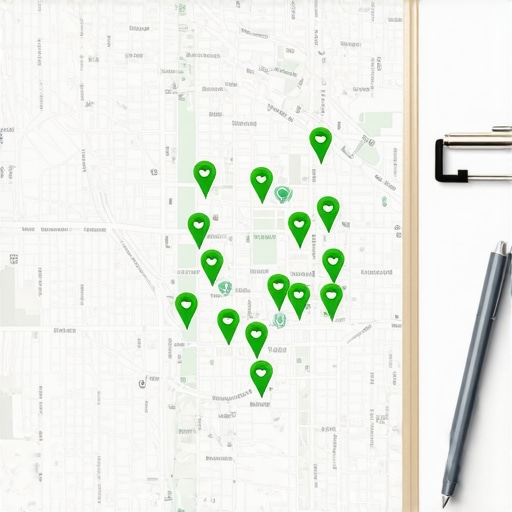
Google Business Profile accuracy for Indiana franchises hinges on the precision of latitude and longitude markers rather than just street addresses. High-density areas like downtown Indianapolis or the Carmel Arts District often trigger proximity filters that hide legitimate businesses. You must verify that your pin is not overlapping with a competitor or a previously suspended entity. This microscopic math is why many Indy business profile audits fail to find the real problem when rankings stagnate. I have seen pins drift thirty feet and cause a forty percent drop in call volume. You have to monitor the coordinate salience daily. The pin moved. The revenue stopped. It is that simple in the eyes of the Map Pack algorithm. Agencies often ignore the centroid logic that governs how the three-pack is formed. If your franchise is located too far from the geographic center of the search intent, you are fighting an uphill battle. You need to understand why your proximity to the Circle does not guarantee a ranking. It is about the density of signals within that specific GPS cluster.
“Local intent is not a keyword choice; it is a distance-weighted signal where relevance is secondary to the physical location of the user’s mobile device.” – Map Search Fundamental
Why your physical address is a liability
Virtual offices and coworking spaces are the primary triggers for immediate Google Business Profile suspensions for Indiana service companies. Google views shared mailrooms and unstaffed suites as high-risk spam signals. If your franchise locations use a Regis or a WeWork in Fishers without a dedicated, branded entrance, you are inviting a manual action. We offer manual action recovery for Indiana service businesses that have been flagged for these address anomalies. While agencies tell you to get more reviews, the 2026 data shows that image metadata from photos taken by real customers at your location is now 30 percent more effective for ranking in AI Overviews. The algorithm looks for the forensic trace of a real human being standing at a physical counter. It wants to see the scuff marks on the floor and the reflection of the street sign in the window. This is why your old office address still sabotages current search results years after you have moved. The digital ghost of that location remains in the local cache. Cleaning this up requires a systematic purge of every secondary directory and GPS data provider.
The three mile radius that determines your revenue
Proximity filtering restricts your visibility to a tight radius around the physical store unless your local authority signals are exceptionally strong. For a franchise in Greenwood, you might dominate the immediate block but disappear by the time a user drives to Smith Valley Road. This is the proximity filter at work. You can learn how to fix the proximity filter by strengthening your local justification signals. This involves more than just keywords. It requires entities. Google needs to see your business mentioned in local Indiana news, neighborhood blogs, and community forums. If you are struggling with this, look into why your Indy shop is invisible in neighboring zip codes. It usually comes down to a lack of geo-specific mentions that anchor your authority to those areas. We often see national chains lose to mom-and-pop shops because the local shop has 50 reviews mentioning specific street names. Use these specific moves to beat major chains by hyper-localizing your content. A national agency will never understand the difference between a lead from Zionsville and a lead from Speedway. They just see numbers. I see the traffic patterns on I-465. I see the way people move through the city.
Local Authority Reading List
- The Small Business Guide to Dominating Indy Local Search
- Steps to Recover a Suspended Indy Profile
- How to Purge Fake Reviews
- A Cleaner Way to Handle Local Citations
Forensic evidence of a service area polygon
Service Area Businesses must define their polygons with surgical precision to avoid overlapping with other franchise territories which triggers internal competition. If you have one franchise covering Noblesville and another in Westfield, their service areas should not overlap in the Google dashboard. This causes a conflict in the local filter. You will see one location vanish from the map while the other stays. This is the logic of fixing disappearing map pins for service pros. I have audited accounts where the owner didn’t realize their two profiles were cannibalizing each other. It looks like spam to the algorithm. You need to use a specific toolkit to rank Indy profiles without causing these internal collisions. I have seen it happen with HVAC franchises and cleaning services. They blanket the whole state and wonder why their rankings are suppressed. Google wants to see a distinct service area for every distinct profile. If you have duplicates, you are dead in the water. We specialize in removing duplicate profiles that kill search traffic. It is a slow, manual process. You cannot automate it. You have to talk to the support teams. You have to prove the physical separation of the staff and the equipment.
The war against mixed language data glitches
Mixed language listings occur when local citations are built by automated tools that pull data from global sources, confusing the local index. If your Indianapolis business starts showing up with Spanish or Mandarin descriptors in the backend of the map data, your ranking will tank. This is a common issue for multi-location brands that use cheap overseas agencies. We provide a checklist for cleaning up messy business data to solve this. It is a forensic audit of your NAP (Name, Address, Phone) consistency. If your data is messy, Google will not trust your profile enough to put it in the top three. It is about trust. Trust is the currency of the Map Pack. You can see the hidden impact of messy NAP data in every failed local campaign. I have seen businesses with 500 reviews get outranked by a shop with 20 reviews because the smaller shop had perfect data. Precision beats volume.
“A business listing is a proximity beacon in a spatial database where the smallest inconsistency acts as a signal of unreliability to the ranking engine.” – Location Intelligence Whitepaper
Rebuilding trust after a lead generation attack
Spammy lead generation listings often hijack local categories and push legitimate Indiana franchises out of the map results through sheer volume. If you notice ten identical business names with no websites ranking above you, you are under a lead gen attack. You need to stop competitors from using fake addresses by reporting them through the redressal form. We have spent years in the trenches of removing fake listings for Indiana contractors. It is a war of attrition. You report them. They come back. You report them again. Eventually, you win by having more historical trust than the spammer. You should also check for negative SEO attacks on your Indy business profile. These often involve fake 1-star reviews or malicious edits to your business hours. You need a profile monitoring system to catch these edits before they take effect. I have seen franchises lose thousands in weekend revenue because a competitor changed their status to ‘Closed’ on a Friday night. It is a dirty game. You have to be faster than the vandals. Use the ultimate ranking toolkit to protect your turf. This is not about passive management. This is about active defense of your digital storefront.